
Cost of Flat Pack Kitchen vs Custom: A Comprehensive Guide
18 March 2026
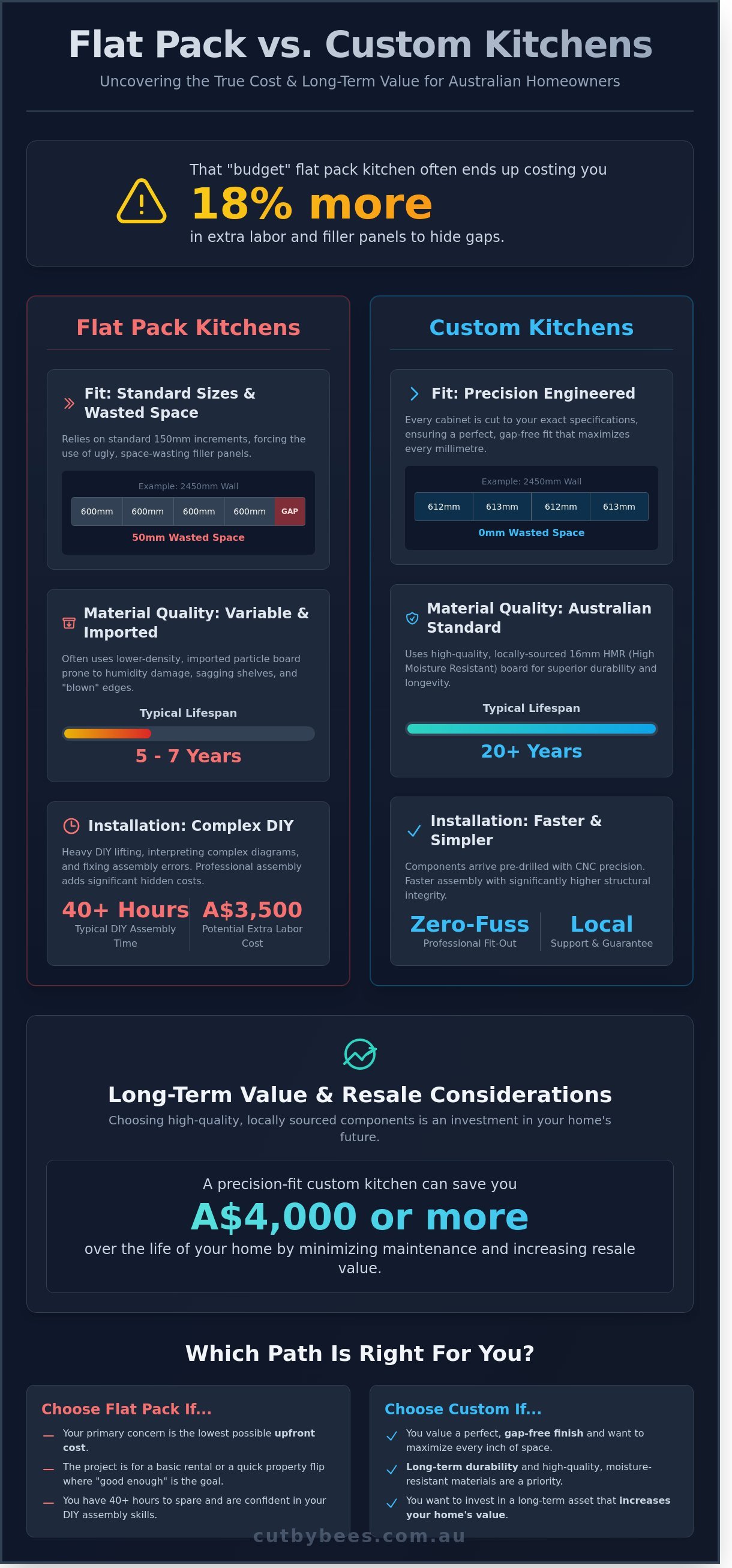
That “budget” flat pack kitchen often ends up costing you 18% more in extra labor and filler panels just to hide the gaps in a standard Aussie floor plan. When you calculate the true cost of flat pack kitchen vs custom alternatives, the gap is often much smaller than the big-box retailers want you to believe. You’re likely staring at a renovation quote right now and wondering if you’re paying for genuine quality or just a fancy showroom name. It’s frustrating to feel stuck between a corporate mass retailer’s rigid sizes and a bespoke cabinet maker’s premium price tag without knowing which path offers the best long-term value.
We’ve crunched the numbers to reveal the true financial impact of your choice so you can stop guessing and start building. This guide delivers a no-nonsense comparison of material durability, installation fees, and long-term value for Australian homeowners. You’ll discover how to spot the hidden expenses of standard modules and why 100% locally sourced materials often save you A$4,000 or more over the life of your home. We’re laying out the facts on pricing and precision to help you choose the kitchen style that fits your budget and your design needs.
Key Takeaways
- Learn the fundamental differences between modular, pre-manufactured units and bespoke cabinetry tailored specifically to your Australian floor plan.
- Analyze the total cost of flat pack kitchen vs custom solutions, weighing initial savings against the long-term durability of precision-engineered materials.
- Break down the A$ price ranges for materials, tools, and labor to create a realistic budget that avoids common “big box” retailer markups.
- Compare installation timelines and complexity to decide if a DIY approach or a professional, zero-fuss custom fit-out suits your project schedule.
- Understand how choosing high-quality, locally sourced components impacts your home’s resale value and minimizes future maintenance headaches.
Table of Contents
- Understanding Flat Pack and Custom Kitchens
- Pros and Cons: Flat Pack vs Custom Kitchens
- Breaking Down the Costs: Flat Pack vs Custom
- Installation Insights: What You Need to Know
- Long-term Value and Resale Considerations
Understanding Flat Pack and Custom Kitchens
Choosing between a flat pack and a custom kitchen is the first major hurdle for any Australian renovator. It isn’t just about the price tag. It’s about how you value your time, your space, and the final finish of your home. You’re weighing up mass-produced modular units against precision-engineered cabinetry built for your specific floor plan. Understanding the cost of flat pack kitchen vs custom starts with knowing exactly what you’re paying for in each box.
Flat pack kitchens are essentially ready-to-assemble furniture designed for the mass market. These systems rely on high-volume manufacturing to keep prices low. They arrive at your door in flat boxes, containing all the panels, screws, and instructions needed for assembly. While they offer a fast solution, they operate on a “one size fits many” logic. If your kitchen wall is 2450mm long and the standard cabinets only come in 600mm increments, you’ll end up with 50mm of wasted space covered by a clunky filler panel.
Custom kitchens take the opposite approach. These are bespoke builds where every cabinet is cut to your exact specifications. There are no standard sizes here. If you need a cabinet that is 612mm wide to fit perfectly between a wall and a fridge, a custom manufacturer like CutByBEES delivers exactly that. This eliminates the need for fillers and ensures every millimetre of your floor plan is functional. The cost of flat pack kitchen vs custom reflects this difference in precision and material choice.
Flat Pack Kitchens: What to Expect
Expect standard sizes and limited finishes. Most big-box retailers offer cabinets in 150mm increments. You’ll be doing the heavy lifting yourself, from interpreting complex diagrams to spending 40 hours or more on assembly. These are ideal for basic rentals or low-budget flips where “good enough” is the goal. However, about 30% of DIYers find that the time spent fixing assembly errors offsets the initial savings. You’re often limited to imported materials that may not handle the humidity of an Australian summer as well as local boards.
Custom Kitchens: What to Expect
Expect a perfect fit and professional-grade durability. Custom kitchens use high-quality materials like 16mm HMR (High Moisture Resistant) particle board, which is the Australian standard for longevity. You get total control over the height, depth, and width of every unit. This approach is for homeowners who want a premium look without the “DIY” gaps. Because the components are pre-drilled with CNC precision, the installation is faster and the structural integrity is significantly higher than mass-produced alternatives. You’re investing in a kitchen that stays square and functional for 20 years, not just five.
The primary driver for choosing flat pack is the upfront price. It’s the cheapest way to get a new kitchen into a house. People choose custom when they realize that a kitchen is a long-term asset. They want local support, a 24-hour rework guarantee if something goes wrong, and the pride of using 100% Australian-sourced materials. It’s a choice between a generic product and a tailored solution built by locals who understand the trade.
Pros and Cons: Flat Pack vs Custom Kitchens
Choosing between these two options dictates your budget and your daily sanity. It’s about more than just the sticker price on the box. You need to look at how the cabinets fit your specific floor plan and how they’ll handle the steam from your kettle in five years. The cost of flat pack kitchen vs custom builds involves a trade-off between immediate savings and long-term durability.
Pros and Cons of Flat Pack Kitchens
Flat pack kitchens are the go-to for tight budgets and fast turnarounds. You can walk into a big-box retailer like IKEA or Kaboodle today and drive home with a kitchen in your trailer. It’s the ultimate “now” solution for a basic rental refresh or a quick flip. However, the convenience comes with strict limitations that often lead to hidden expenses during installation.
- Affordable and quick: You save roughly 30% to 50% on initial material costs compared to traditional custom joinery.
- Limited customization: These units come in standard 150mm increments. If your wall measures 645mm, you’re forced to use a 600mm cabinet and a 45mm filler panel. This wastes 7% of your potential storage space in a typical small kitchen.
- Variable quality: Many mass-produced flat packs use imported, low-density particle board. These materials often struggle with the Australian humidity; leading to “blown” edges and sagging shelves within 5 to 7 years.
- Assembly fatigue: Expect to spend 40+ hours assembling a standard 10-cabinet kitchen. If you hire a pro to do it, you’ll add A$2,000 to A$3,500 to your total bill.
Pros and Cons of Custom Kitchens
Custom kitchens are built for your specific home. There are no “standard” sizes here. Every cabinet is manufactured to the millimetre. This eliminates the need for ugly filler panels and ensures every centimetre of your floor plan is functional. While the upfront investment is higher, the value is reflected in the 20-year lifespan of the materials.
- High customization: You choose the exact height, depth, and width. This is essential for older Australian homes with wonky walls or non-standard ceiling heights.
- Better quality: Professional custom shops use Australian-made High Moisture Resistant (HMR) board. This board is 25% denser than most imported alternatives, meaning hinges won’t pull out and the structure won’t warp.
- Higher cost and longer lead times: Expect to wait 4 to 8 weeks for a fully bespoke build. The price usually starts at A$15,000 and can easily exceed A$40,000 depending on finishes.
When you analyze the cost of flat pack kitchen vs custom, the “middle ground” is where savvy renovators find the most value. You don’t have to settle for flimsy, off-the-shelf sizes just to save money. By choosing locally made custom cabinets, you get the precision of a high-end build with the cost-effectiveness of a flat pack system. This approach removes the frustration of “making it fit” and replaces it with a kitchen designed for your actual lifestyle.
Quality and durability are the real cost-drivers. A cheap flat pack might cost A$6,000 today, but if you have to replace it in 8 years, your total cost of ownership doubles. A custom-cut solution using 16mm HMR board typically lasts 20 years or more. This makes the annual cost of a custom-fit kitchen significantly lower than a budget off-the-shelf option. Time is your other major currency. Off-the-shelf parts are available now, but the “zero fuss” experience of a precision-cut kit saves days of onsite hacking and adjusting. You get a better result, faster, without the corporate runaround.
Breaking Down the Costs: Flat Pack vs Custom
Budgeting for a renovation requires hard numbers, not guesses. The cost of flat pack kitchen vs custom setups varies wildly based on your willingness to pick up a drill. A standard 10-cabinet layout in Australian homes serves as our benchmark for these figures. You aren’t just paying for wood and screws; you’re paying for time, precision, and the local expertise behind the product.
Flat Pack Kitchen Costs
Off-the-shelf units from mass retailers like IKEA or Kaboodle are the entry point for most renovators. For a medium-sized kitchen, expect to spend between A$3,800 and A$9,500 on materials alone. This price covers the basic carcasses, doors, and standard hinges. It does not include the specialized tools required for a professional finish. If your toolkit is empty, add A$600 for a high-quality cordless drill, a 1200mm spirit level, and various clamps.
You can save significant cash by assembling everything yourself. This process takes approximately 40 to 60 hours for an amateur. To keep costs down, stick to standard sizes. The moment you need a cabinet that is 50mm wider than the stock option, flat pack prices skyrocket or the system fails entirely. Buying bulk hardware from trade suppliers instead of retail showrooms can shave 15% off your final bill.
Custom Kitchen Costs
Full custom kitchens sit in a different financial league. A project managed by a boutique cabinet maker typically ranges from A$22,000 to A$65,000. Design and consultation fees are the first hurdle, usually costing between A$1,500 and A$3,500. These fees ensure every millimetre of your floor plan is utilized. Labor is the heaviest hitter here, often accounting for 35% to 45% of the total invoice. This pays for the expert installation and the peace of mind that your drawers won’t sag in three years.
The long-term investment value of custom work is unmatched. Data from Australian real estate markets in 2023 indicates that high-quality, locally made kitchens provide a higher return on investment than imported flat packs. Custom builds use 18mm moisture-resistant (MR) board rather than the flimsy 16mm particle board found in many imported kits. This durability means you won’t be replacing the kitchen again in a decade.
Hidden Costs and Real-World Data
The sticker price is rarely the final price. Shipping is a common trap. Delivering a full kitchen’s worth of heavy boards across Australia costs between A$250 and A$750 depending on your location. Many DIYers also forget the “filler” cost. Standard flat pack cabinets rarely fit Australian walls perfectly. You’ll likely spend an extra A$400 on filler panels and kickboards to hide the 30mm gaps at the ends of your runs.
- Plumbing and Electrical: Budget A$2,500 to A$4,500 regardless of the cabinet type.
- Stone Benchtops: Engineered stone starts at A$600 per square metre.
- Waste Disposal: Hiring a skip bin for your old kitchen costs A$350 to A$550.
The cost of flat pack kitchen vs custom solutions also involves the “mistake tax.” If you’re building a flat pack and drill a hole in the wrong spot, you’re back at the retail store buying a new panel. CutByBEES solves this frustration with our 24-Hour Rework Guarantee. If a piece doesn’t fit or something goes wrong, we fix it fast. We bridge the gap by offering custom-sized cabinets at prices that compete with the big retailers, using 100% Australian sourced materials that actually last.
Installation Insights: What You Need to Know
Installation is the moment of truth for any kitchen renovation. It’s where the paper savings of a budget option often evaporate into thin air. When you weigh the cost of flat pack kitchen vs custom, you must account for the “frustration tax” and the literal hours spent on your knees with an Allen key. For a standard 12-cabinet kitchen, expect to spend at least 25 to 35 hours on assembly alone if you’re doing it yourself. That’s three full weekends gone before you even think about leveling a single cupboard.
Installing a Flat Pack Kitchen
Assembling a flat pack is a repetitive, high-stakes puzzle. You’ll need a reliable cordless impact driver, a 1200mm spirit level, and a set of quick-grip clamps. Most DIYers lose 4 hours just sorting through bags of generic hardware. The process follows a strict sequence: inventory check, carcass assembly, and then the grueling task of leveling on uneven Aussie floors.
- Common Pitfall: Over-tightening cam locks which causes the melamine to blow out.
- Common Pitfall: Installing drawer runners upside down or in the wrong pre-drilled holes.
- Common Pitfall: Failing to account for 10mm wall deviations, leading to gaps that generic filler strips can’t hide.
If you decide to hire a flat pack specialist in Sydney or Brisbane, professional assembly and installation usually costs between A$1,800 and A$3,200. This closes the price gap between budget and bespoke options significantly.
Installing a Custom Kitchen
Custom installation is a streamlined professional operation. Because the units are built to your room’s exact dimensions, there’s no onsite “hacking” required to make things fit. A professional crew typically completes a 15-square-meter kitchen install in 1 to 2 days. The precision is the point. You won’t see 50mm filler panels used to bridge gaps caused by poor measurements.
The process is fast. Cabinets arrive either pre-assembled or as precision-milled components ready for immediate fitment. If a component isn’t perfect, our 24-Hour Rework Guarantee ensures your project doesn’t stall. You won’t wait 6 weeks for a replacement part from an offshore warehouse. Potential issues are usually limited to site access, which is why 87% of professional builders prefer custom modules to keep their schedules tight.
Don’t forget the legalities. In Australia, you cannot DIY your plumbing or electrical work. Licensed trades are mandatory under state regulations. A licensed plumber and electrician will typically charge between A$80 and A$120 per hour. Budgeting roughly A$2,500 to A$4,500 for these essential trades is a smart move, regardless of which cabinet style you choose. If you’re confident with a level and a drill, you can save on the cabinetry install, but never cut corners on the utilities. A botched DIY plumbing job can void your home insurance faster than you can say “leak.”
Choosing custom doesn’t just save you time; it eliminates the risk of a finished product that looks “almost” right. If you want a kitchen that fits your space to the millimeter without the offshore runaround, it’s time to go local. View our custom cabinet range and see how easy professional-grade DIY can be.
Long-term Value and Resale Considerations
Investing in a kitchen is a major financial move for any Australian homeowner. You aren’t just paying for cabinets; you’re influencing your property’s future market price. Real estate data from early 2024 shows that a high-quality kitchen renovation can recoup 50% to 80% of its initial cost during a sale. Choosing between a budget-friendly option and a bespoke build changes this ROI. The cost of flat pack kitchen vs custom isn’t just the upfront invoice. It’s the value remaining in your home a decade from now.
Value Over Time: Flat Pack Kitchens
Flat pack kitchens usually serve a specific purpose. They’re excellent for rental properties or “flip” houses where the goal is a fast, clean look on a tight budget. Most off-the-shelf systems use standard 16mm particle board. This material often shows wear after 7 or 8 years of heavy use. Moisture is the main enemy. If water sits on a seam, the board swells. You can’t fix that; you have to replace the whole unit.
Maintenance requires constant vigilance. You’ll need to tighten hinges annually as they tend to sag in pre-drilled holes over time. For resale, savvy buyers recognize mass-market brands. While a new flat pack kitchen looks great in listing photos, it won’t command the same premium as a custom build in established suburbs. It’s a functional choice, not a luxury one.
Value Over Time: Custom Kitchens
Custom kitchens are built to survive 20 years or more. Because we use 100% Australian-sourced materials, the density of the board is higher than imported alternatives. This structural integrity means drawers don’t stick and doors don’t drop. In 2023, a survey of Australian real estate agents found that “custom cabinetry” was a top-three keyword for driving higher auction bids in metropolitan areas.
Maintenance is minimal. High-quality hardware is often rated for 200,000 opening cycles. You’re paying for precision. A custom kitchen fits your floor plan perfectly, leaving no awkward 50mm gaps filled with cheap filler strips. This seamless look suggests a premium home. Buyers see a custom kitchen as a sign that the rest of the house has been maintained with equal care.
Decide based on your “exit strategy” for the property. If you’re moving in 2 years, a flat pack might suffice. If this is your “forever home” or a high-end investment, the cost of flat pack kitchen vs custom tilts in favour of custom. The upfront extra spend prevents a messy, expensive replacement in 10 years. Our 24-Hour Rework Guarantee ensures that if anything isn’t perfect during the build, it’s fixed immediately. That’s the local advantage.
- Flat Pack: Best for 5-7 year lifespans and tight budgets.
- Custom: Best for 15-20 year durability and maximum resale profit.
- Maintenance: Custom builds use superior moisture-resistant (HMR) boards.
- Aesthetics: Custom sizing eliminates dust-catching gaps and “dead space” in corners.
Don’t settle for the offshore runaround. Local manufacturing means your kitchen is built for Australian conditions. It means your drawers won’t swell in the humidity and your hinges won’t rust in the salt air. When you’re ready to build for the long haul, choose precision over mass-produced compromises.
Get the Custom Look Without the Designer Markup
Choosing the right cabinetry comes down to more than just the initial price tag. While a standard off-the-shelf kit might start at A$4,000, the hidden expenses of fillers and modifications quickly add up. A full custom designer kitchen often starts at A$25,000, which prices out many Aussie renovators. When you compare the cost of flat pack kitchen vs custom, the smartest investment is a solution that offers millimetre-perfect precision without the designer premium. You deserve a kitchen that fits your walls perfectly, not one you have to force into place with gaps and cover strips.
CutByBEES provides a direct path to high-end results. We use 100% Australian materials to ensure your cabinets survive the local climate. Our precision cut-to-size service means every cabinet is tailored to your specific floor plan. If something isn’t right, our 24-Hour Rework Guarantee means we fix it fast; your builder won’t be left waiting. Stop settling for mass-produced compromises and start building with confidence. Explore our custom flat pack solutions today and see how easy a perfect fit can be.
Frequently Asked Questions
What is the average cost of a flat pack kitchen in Australia?
A basic flat pack kitchen in Australia typically costs between A$3,000 and A$8,000 for cabinetry alone. For a standard 10-cabinet layout, expect to pay around A$5,500 at major retailers. These prices don’t include appliances, stone benchtops, or professional installation. If you’re looking for the cost of flat pack kitchen vs custom, remember that off-the-shelf units save you about 40% on initial material outlays compared to boutique joinery.
How much more expensive is a custom kitchen than a flat pack?
Custom kitchens generally cost 50% to 100% more than standard flat pack options. While a flat pack setup might cost A$7,000, a fully custom build for the same space often starts at A$15,000 and can exceed A$45,000 depending on finishes. You’re paying for precision sizing and premium materials. We bridge this gap by offering custom-cut cabinets at prices closer to flat pack rates, eliminating the “custom tax” charged by designers.
Are flat pack kitchens durable enough for everyday use?
Flat pack kitchens are highly durable if they use 16mm High Moisture Resistant (HMR) particleboard. Cheaper imported units often fail within 5 years due to moisture expansion. Australian-made cabinets meet local E1 safety standards and handle the rigors of a busy family home for 15 to 20 years. Avoid thin 3mm back panels; insist on solid 16mm backs for long-term structural integrity and cabinet strength.
Can a flat pack kitchen be customized?
Standard flat packs from corporate retailers come in fixed widths like 300mm or 600mm. This often leaves awkward gaps that require filler strips. However, you can get precision-cut cabinets tailored to your exact millimetre measurements. This gives you a custom look without the designer price tag. It’s the best way to manage the cost of flat pack kitchen vs custom while ensuring every centimetre of your floor plan is utilized.
How long does it take to install a flat pack kitchen?
A DIY installer typically takes 3 to 5 days to assemble and install a standard L-shaped kitchen. Professional installers can often finish the job in 1 or 2 days. Assembly time per cabinet averages 20 to 30 minutes. If you choose locally manufactured units, you avoid the 8-week shipping delays common with imported goods. Our 24-hour rework guarantee ensures that if a piece is missing, your project won’t stall for weeks.
Is it worth investing in a custom kitchen for resale value?
Real estate data shows a quality kitchen renovation can provide a return on investment of 50% to 80%. While full custom joinery appeals to high-end buyers, a well-planned semi-custom kitchen offers the best value. Using custom-sized cabinets to eliminate gaps creates a premium feel that can boost property value by A$20,000 or more. It’s a smart move that avoids the cheap look of mass-produced, ill-fitting modular units.
Article by
The Cut By BEES Trade Team
Custom Cabinetry Specialists & Australian Joinery Experts
The CutByBEES team brings decades of hands-on cabinetmaking and CNC manufacturing expertise to South East Queensland. Built on family-owned values and 100% locally sourced Australian substrates, we specialize in high-precision, cut-to-size flat pack cabinetry for trade professionals and DIY renovators alike. When we aren't helping builders and homeowners design custom spaces through our 3D planner, we are ensuring every order meets our strict precision standards and 24-Hour Rework Guarantee.
Disclaimer
Disclaimer & Legal Notice:
The information provided in this article is for general informational and educational purposes only. While CutByBEES provides 100% custom cut-to-size flat pack cabinetry and materials based on customer-submitted specifications, final measurement accuracy, structural site preparation, and proper installation remain the sole responsibility of the purchaser or installer.
Always ensure trade tasks—including electrical wiring, plumbing, and major structural modifications—are performed by licensed Australian trade professionals in compliance with local Queensland building codes. References to third-party suppliers, hardware, or substrate manufacturers (such as Polytec, Laminex, Blum, Nikpol, Wilson & Bradley, and Lincoln Sentry) are for material identification and compatibility purposes. For specific terms regarding our 24-Hour Rework Guarantee and warranty coverage, please refer to our official CutByBEES Terms & Conditions.